

Social Equity Licenses Are 17% of California's Cannabis Retail: A Capitol Compliance Management Investigative Report
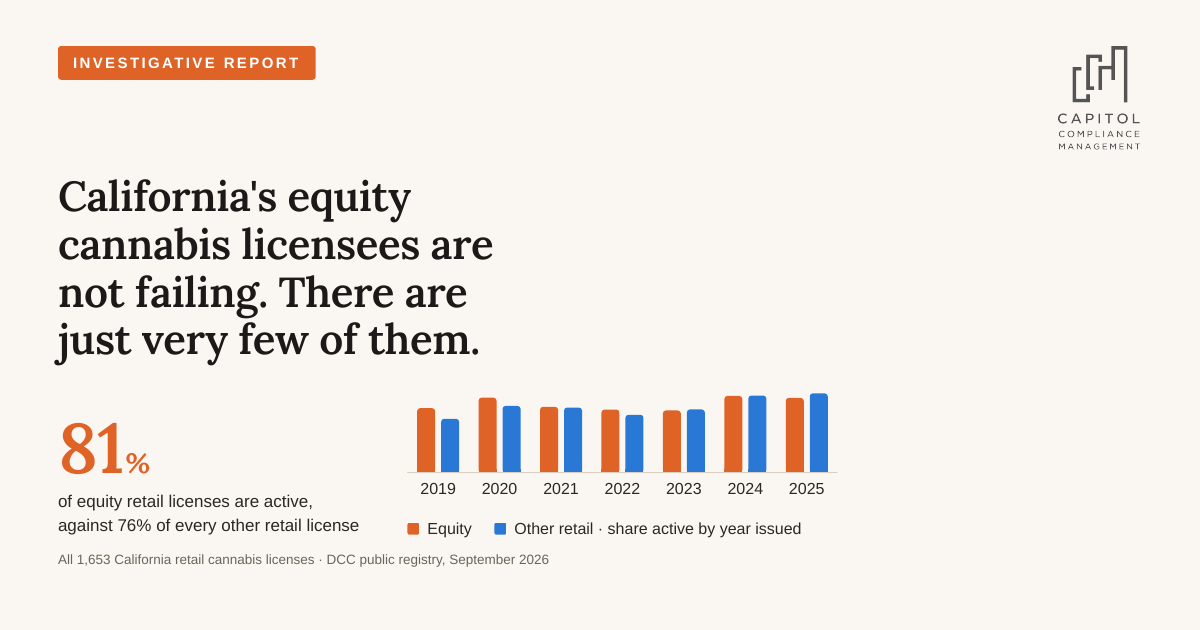
Active cannabis equity licenses slightly outpace other active retail licenses. The investigative report outlines the separation between license status and business success.
The Sacramento consultancy analyzed all 1,653 retail cannabis licenses in the state registry and found that equity licensees keep their licenses as reliable.
SACRAMENTO, CA, UNITED STATES, October 21, 2026 /EINPresswire.com/ -- The California cannabis industry has a settled picture of its social equity licensees: undercapitalized, set up to fail, mostly gone already. An analysis of the state’s own license registry, published today by Capitol Compliance Management (CCM), finds no support for it.
The report, written by Kevin W. McCarty, CCM’s Director of Licensing & Compliance, examines all retail cannabis licenses on record with the Department of Cannabis Control, and finds that California storefront cannabis licenses carrying the state’s equity label were as likely to be active as other licenses issued in the same years from 2019 through 2024.
The finding gives readers a reason to question the idea that equity retailers are less likely to stay licensed. The report also explains why an active license alone cannot show whether a business is profitable or whether its original equity owner remains in control.
California’s cannabis equity programs aim to help people and communities harmed by past cannabis laws enter the legal market. CCM’s study examines one part of their progress: the status of storefront retail licenses identified through the state’s “[Equity Retailer]” label.
Written by Kevin W. McCarty, CCM’s Director of Licensing & Compliance, the report draws on 1,653 storefront retail license records collected from the Department of Cannabis Control on September 25, 2026. It includes active and inactive licenses. Of those records, 281 carried the equity label.
Across the full dataset, 81% of equity-labeled licenses were active, compared with 76% of licenses without the label. Because the equity group’s licenses were younger on average, CCM also compared licenses issued in the same year.
The equity group had an active share on par or higher than the non-equity group in each year from 2019 through 2024. Among licenses issued in 2019, 41 of 52 equity-labeled licenses remained active—about 79%. For licenses without the label, 369 of 559 remained active, or about 66%.
“What stood out to me was how many of these older equity licenses were still active,” said McCarty. “That doesn’t tell us everything about how the businesses are doing, but it gives us a good reason to question the idea that equity retailers are less likely to stay licensed.”
The report separates license status from business success. The records do not show sales, profit, debt or a full history of ownership changes. They also may miss equity businesses that lack the state label. The findings therefore describe the licenses identified in the study, rather than every equity business in California.
The analysis also found that equity-labeled storefront licenses were spread unevenly across the state. Los Angeles County held 156 of the 281 licenses—more than half. Sacramento County held 26, and San Francisco held 19. These counts include inactive licenses and do not measure how many shops are open today.
A separate review of retail, delivery and microbusiness records explored links through shared company names, business names and addresses. Most groups in both the equity and comparison categories were linked to one location. The report does not treat those links as proof of common ownership or as evidence that equity businesses face a greater barrier to expansion.
CCM also compared state records with Sacramento’s local CORE equity program list. Among the participants it matched, some storefront and delivery businesses lacked the state label. This shows why one public list may not capture everyone taking part in equity programs.
The renewal calendar offers a practical planning point. Of the 1,265 active storefront retail licenses in the study, 717—about 57%—had expiration dates from April through July 2027. CCM encourages operators to track their own deadlines and review business procedures, inventory records, staff training and local permit conditions before renewal.
The full report, with data tables and method notes, is available at https://www.ccmup.com/resources/equity-cannabis-licensing-report-2026. A summary is on the CCM blog: https://www.ccmup.com/blog/california-equity-cannabis-retailers-license-records. Journalists and researchers can request the underlying license extract at compliance@ccmup.com.
About Capitol Compliance Management
Capitol Compliance Management is a Sacramento-based cannabis compliance consultancy serving California operators. The firm helps businesses obtain licenses, maintain compliance and address regulatory problems. Services are available in English and Spanish. CCM is not a law firm; on enforcement matters, it works alongside the operator’s cannabis attorney.
Disclosure
CCM serves equity license holders. McCarty is listed as an owner on two equity-labeled licenses in the dataset.
Kevin W. McCarty
Capitol Compliance Management
+1 916-581-1420
compliance@ccmup.com
Visit us on social media:
LinkedIn
Legal Disclaimer:
EIN Presswire provides this news content "as is" without warranty of any kind. We do not accept any responsibility or liability for the accuracy, content, images, videos, licenses, completeness, legality, or reliability of the information contained in this article. If you have any complaints or copyright issues related to this article, kindly contact the author above.
